

Opening thoughts. You may have very valid views on this, but I believe the headline development as we head into the first edition of Wired Wisdom for 2026 is this — India’s broadband subscriber base has crossed the 1 billion (100.37 crore to be specific) mark, now that the official TRAI numbers for the month of November 2025, have been firmed up. For context, this number was 131.49 million (13.15 crore) in the same month of 2015, a growth of 6 times. This growth has been built on wired broadband (fiber and DSL, for instance) as well as the momentum of wireless (5G and before that 4G), across devices including home Wi-Fi and smartphones. I’ve said it time and again that India’s broadband growth needs a greater contribution from the wired broadband space, because 5G is pulling most of the weight at this time.

EDITOR’S CORNER: CES, AND A SUBTLE REALIGNMENT
The annual Consumer Electronics Show (CES) at Las Vegas would be underway by the time you read this, and as is the case every year, I like to keep a keen eye on the build-up (making a point of not being in Las Vegas; it is more efficient to cover this from afar) — that’s when most interesting developments seem to happen. Summarising the most interesting ones from a rather packed set.
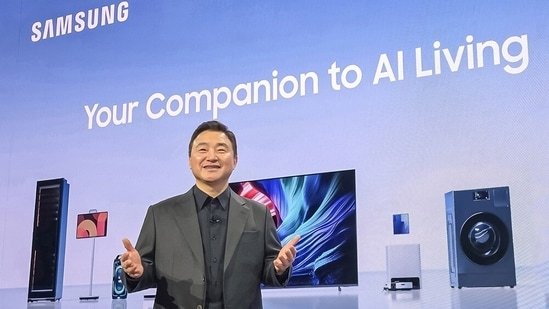
Samsung sees AI as something that’ll work better in an ecosystem rather than as an isolated chatbot. The “Companion to AI Living” vision will build with Samsung’s already very extensive AI-enabled, connected ecosystem, by integrating what they call a ‘true AI companion’ experience in their daily life. Difficult to bet against Samsung’s intention or scale, having covered the Bespoke AI for India trajectory that focuses on localisation, transforming Bixby AI into an assistant, and SmartThings as the key for monitoring and managing connected devices at home. “Samsung is building a more unified, more personal experience across mobile, visual display, home appliances and services. With our global connected ecosystem, and by embedding AI across categories, Samsung is leading the way to offer more meaningful everyday AI experiences,” says TM Roh, CEO and Head of Samsung’s Device eXperience (DX) Division. The Tizen OS based new, ultra-thin OLED S95H as well as The Freestyle+ are just two examples from a broader refreshed device lineup that is ushering in the new AI vision.

That isn’t the only big announcement from Samsung. The stunning Timeless Frame aesthetic, first seen in Samsung’s 2013 Timeless Gallery design, makes a statement with what is the world’s first 130-inch Micro RGB TV (the R95H model, to be specific). “Micro RGB represents the peak of our picture quality innovation, and the new 130-inch model takes that vision even further. We’re reviving the spirit of our original design philosophy introduced more than a decade ago to deliver an unmistakably premium display, engineered with technology for a new generation,” says Hun Lee, Executive Vice President of the Visual Display (VD) Business at Samsung Electronics. It isn’t all show, the R95H gets substance from Samsung’s proprietary Glare Free technology, image processing tools such as the Micro RGB AI Engine Pro, Micro RGB Color Booster Pro and Micro RGB HDR Pro, as well as support for HDR10+ ADVANCED standard and integrations of Microsoft Copilot and Perplexity’s AI tools.

Every year, LG does something that’s enough to claim they’ve made the slimmest TV, most flexible display or something on those lines, and we never really get to see these TVs later. The 2026 edition is no different. This year, leading that familiar conversation is The Wallpaper TV, or the LG OLED evo W6, which is 9mm thin. LG says this has been achieved by “meticulous miniaturisation of essential components and a complete re-engineering of its internal architecture”. The second piece of this puzzle is LG’s True Wireless technology, for the inputs that are to be found on the Zero Connect Box, which can be positioned up to 10 meters away from the TV. Price and availability of this innovation, particularly the India specifics, are (as expected) missing for now.

The BlackBerry may be back, just about. Clicks, the British startup that is well known for the “Clicks for iPhone” keyboard case accessories, is making a bold bet in the smartphone space — a phone that is an ode to the good old days of physical QWERTY keyboards, and very similar to BlackBerry phones in terms of design. The Clicks Communicator has Android at its foundation (nothing else would’ve worked, would it?) with of course a physical keyboard, a 4-inch OLED display, a 50-megapixel main camera alongside a 24-megapixel selfie sensor, and hardware level encryption. This is currently up for reservation with an expected launch price of $399, and will support WhatsApp (in case you were wondering). I absolutely wouldn’t mind this as my second phone, or even the primary work phone.

We could (and should, hopefully) see more of this in 2026. Chinese gaming brand 8BitDo is showing the way with a teaser of the FlipPad, a flip-style gamepad designed for mobile gaming. Works with Android phones and the Apple iPhones, and the company says this accessory is officially supported by Apple. Will be available for purchase at some point in the summer, and pricing details are expected then.

Finally, LEGO! Lego has announced a “Smart Play System” featuring Smart Bricks, Smart Minifigures and Smart Tags. Each piece contains a 4.1mm ASIC chip, sensors and copper coils, along with a unique Digital ID. This allows individual Lego pieces to detect distance, direction and orientation relative to others, triggering sounds, lights and contextual reactions during play. Preorders start soon, and I’d love to know the price tags for these sets.
ANALYSIS: INDIA’S SMARTPHONE INTENT STRUGGLE
India’s smartphone market continues to expand sharply, with shipment volumes hitting multi-year highs in late 2025. Yet despite this growth and a robust local manufacturing base supported by initiatives such as Make in India and related incentives, homegrown brands remain conspicuously absent from the major market share charts. Global players — particularly Vivo, Samsung, Oppo and increasingly Apple — dominate the landscape, leaving Indian brands (of which there aren’t many now as it is) largely in the periphery.
At the heart of this paradox is a structural weakness. Indian phone companies have historically failed to innovate at the level required to compete in a rapidly evolving smartphone ecosystem. Analysts I spoke with trace much of this failure to a foundational nature of early Indian brands like Micromax (including its Yu sub-brand), Karbonn, Intex and Spice, but not limited to just these. Rather than developing deep research and development (R&D) capabilities, proprietary intellectual property (IP) or differentiated software platforms, these brands largely functioned as resellers of Chinese-made devices, often sourcing fully built products and selling them under local labels, with minimal investment in core technology.

This model left Indian brands exposed on two fronts, that is cost and consumer perception. When Chinese competitors such as Xiaomi entered the market with disruptive price-to-specification products, for example the Mi 3 (if I may, a jog down the memory lane, with a link to my piece from Mint’s Business of Life at that time) that began significantly reshaping expectations as early as 2014, Indian brands struggled to match that combination of affordability, performance and user experience. Flagship-esque specs at ₹13,999 then, was unheard of. Without hardware scale, supply-chain control, and other pieces of the puzzle, domestic brands were quickly outpaced. Little surprise there.

There are exceptions — Lava International stands out, with notable year-on-year growth in lower price bands and balancing a strong portfolio around the ₹10,000 price point, as well as some more expensive phones. I reviewed their latest premium smartphone, the impressive Agni 4, and it is clear there is an intent to build with competitive hardware while not ignoring the modern talking points such as an India-centric AI assistant called Vayu AI, which to be fair, seems quite culturally tailored as far as its toolset is concerned. Still, analysts caution that Lava’s connection with core youth and aspirational buyers remains tenuous, and that consistency in innovation and strategic clarity will be essential if it is to scale meaningfully. I’d say upgrading the brand with the buyer’s evolving social standing and financial strength, is important.
Looking ahead, the next significant inflection point may well be a transition to 6G and increasingly AI-driven mobile experiences — we don’t know when, but it is going to be soon and shall present both a challenge and a potential opening. But without substantive investment in R&D, intellectual property, and authentic innovation, analysts remain sceptical that Indian phone brands can craft a sustainable resurgence in a market already crowded with global competitors. But we collectively hope.