


2025 began on an alarming note for the global economy, as Donald Trump started his second stint in the White House. His first presidency had seen the US switch gears from keeper of the rules-based global economic order to its executioner.
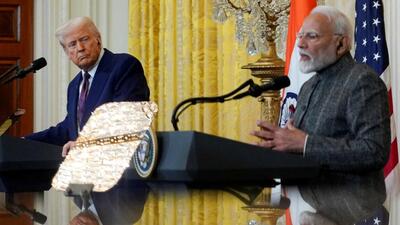
The dominant sentiment in India was not of concern, however, as Trump was perceived to be the Government of India’s friend.
By August, as Trump imposed his so-called reciprocal tariffs on the world — they were first announced in April but put on hold — and as India was slapped with a steep 25%, this goodwill was on thin ice. By the time Trump imposed an additional tariff of 25%, citing Russian oil imports — something the Biden administration had no problem with, and something bigger buyers of Russian oil such as China didn’t face action for — the Indo-US economic bonhomie was deep underwater.
Any other economy that saw its biggest export market being virtually shut off would have suffered a lot of pain. But India is ending the year in a rare “Goldilocks” zone of 8% growth and less-than-2% inflation. Sure, some of the shine in the growth-inflation combo is statistical and technical, but it would be wrong to say India is not in a good place.
The question the economy faces going into 2026 is not whether the 8%-2% combo will persist; nobody, including the government, expects it to (although nobody expects a movement to the other extreme either). The question is: Will the domestic economic tailwinds be joined by external tailwinds, or continue to face global headwinds?
Trade deals, not just with the US but with other major trading blocs such as the EU, are just one aspect of it. This is not to undermine their importance, or the complexity of the trade-offs involved. But the fact of the matter is that the global economy is undergoing multivariate churn, and Trump and his many wannabe nativist, populist Western European political peers are only part of this problem.
The biggest economic question currently in proverbial economic labour is whether the world will see the Artificial Intelligence bubble burst in 2026. The valuations of tech companies are, to borrow a phrase Stalin used, “dizzy with success”. Insane levels of debt, sub-par revenue and profit possibilities and private credit fuelled deals which have operated beyond the sanitised boundaries of banking put in place after the 2008 crash all point to a perfect storm breaking sometime in the future.
As Wall Street and Silicon Valley dance their dangerous AI-bubble tango, China has emerged as a manufacturing behemoth with an excess capacity that can overwhelm pretty much everybody’s industry. 2025, as far as China is concerned, will be remembered as the year its merchandise trade surplus crossed the $1 trillion threshold.
India will have to brace for both these headwinds. A global financial market in turmoil doesn’t bode well for any economy, more so one that runs a trade deficit and is dependent on capital flows not just for setting up greenfield projects but also in the financial sector. China’s emergence as a global economic giant that has suppressed its domestic consumption to create a manufacturing powerhouse spanning the most mundane and cutting-edge products is also bad news for a country like India that is at the cusp of becoming the third-largest economy but is still way below its potential in manufacturing output, employment and exports.
The dilemma of whether to deal with this problem by cutting individual deals with the US and China or by investing in resuscitating what looks like a dying rules-based order isn’t an easy one to resolve. It is this that will be the central policy challenge as far as the Indian economy is concerned, in 2026.
Success, on this front, will require not just intellectual clarity but also a physiocratic will to pump-prime the production capabilities of the economy in order to strengthen the bargaining position of the country in international negotiations. It will also require cleverly hedging political capital to make pragmatic gains in the medium to long term. And most importantly, the economy will have to preserve its macroeconomic stability, to minimise damage from a global financial storm (should it materialise).
Can India face up to the challenge? There are factors beyond any government’s control to consider too: oil prices, the monsoon etc. And there are factors that seem to have been part of a Faustian bargain to retain power, such as the growing trend of cash transfers at the state level, notwithstanding the qualitative and quantitative damage they are causing to the larger fiscal environment.
In the end, politics, and by extension political economy, boil down to the art of the possible. That’s what separates the politicians from the statesmen.