


To fast-track the redevelopment of Mumbai’s slums and move toward a slum-free city, the Maharashtra government has issued a new order stating that individual slum-dwellers’ consent will no longer be required for the group redevelopment of slum clusters, according to a Hindustan Times report.
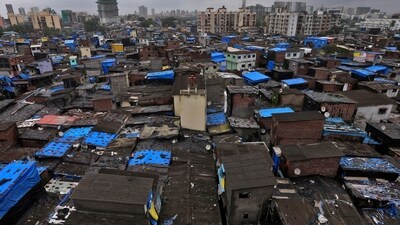
For the first time, the government has also allowed the inclusion of land owned by the central government for a state redevelopment scheme. “Land owned by the central government may also be included upon obtaining necessary permissions from concerned authorities,” the report quoted the government resolution as saying.
The state government has appointed Slum Rehabilitation Authority (SRA) as the nodal Agency for implementing these cluster redevelopment schemes. It will identify slum cluster areas which need approval from the high power committee (HPC) of the state housing department.
According to a government resolution (GR) issued on November 13, the state has also allowed slum clusters on a minimum contiguous land area of 50 acres, of which more than 51% shall be slum area. Schemes already sanctioned under Regulation 33(10) of the Development Control and Promotion Regulations (DCPR) can be included in the cluster redevelopment scheme, the report said.
This is also applicable to non-slum structures, including industrial, commercial and warehousing buildings within the designated cluster area. Most importantly, this includes structures that fall under coastal regulation zone (CRZ) regulations, the report said.
The state government has appointed Slum Rehabilitation Authority (SRA) as the nodal Agency for implementing these cluster redevelopment schemes. It will identify slum cluster areas which need approval from the high power committee (HPC) of the state housing department.
It said that land leased by the government or semi-government bodies can be included in the scheme, provided rehabilitation is done according to DCPR 2034 and compensation is given to the respective authorities.
The scheme can also be implemented for structures falling under CRZ–I and II regulations. “Slums on CRZ I and II may be integrated, with in-situ or alternative rehabilitation permitted within a 5-km radius as per CRZ and DCPR norms,” said the GR.
What happens to ongoing slum rehabilitation authority projects?
“For ongoing SRA projects within the cluster area, existing buildings with occupancy certificates may be demolished, reconstructed or retained,” the order said, allowing the developer to undertake implementation in phases. “At each stage, rental compensation for displaced slum-dwellers must be deposited with the SRA,” a senior housing official was quoted by the newspaper as saying.
Also Read: Maharashtra government approves slum cluster redevelopment scheme for Mumbai
Can private developers participate in the scheme?
The scheme can be implemented either by a joint venture with a government entity or by appointing a private developer through a transparent process, he said. “Developers holding more than 40% of the total cluster area shall be given preference for implementation, subject to approval from the HPC,” the official was quoted as saying.
According to the order, private developers may be appointed either through public-private partnership or through open tendering by the public agencies. If a developer already holds 40% or more area of the cluster site, they may be given priority to implement the scheme. Further, if there are existing multi-storey buildings on non-slum parts in the designated area, the developer will be responsible for obtaining their development rights.